Taking client relationships from fixing to flourishing
October 1, 2026
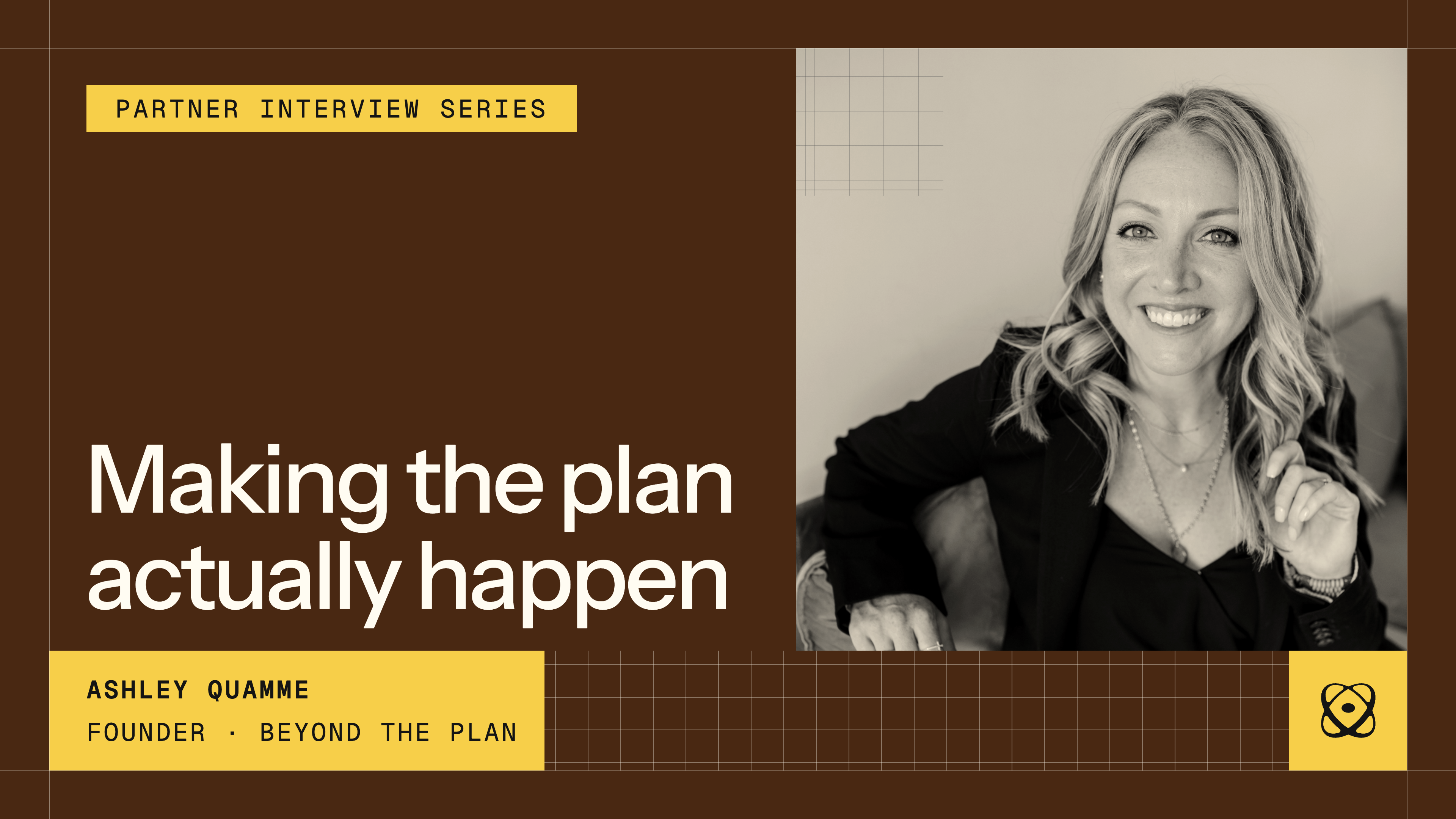
This is the latest installment of our Partner Interview Series, where Gabe sits down with the people who help advisors and sales teams run their business, and gets into where AI fits into that today.
Next up is Ashley Quamme, founder of Beyond the Plan, a fractional chief behavioral officer practice that helps independent RIAs build deeper, more human client relationships. Ashley's background is in marriage and family therapy. She was licensed for well over a decade, specializing in working with couples and families, before bringing that training into financial planning. She's married to a financial planner herself, and runs Beyond the Plan alongside her partner, Dr. Meg Lertz, working with firms from large enterprises down to independent RIAs in the $3 to $750 million AUM range.
Tell us about Beyond the Plan. What led you to start it, and what's this fractional chief behavioral officer title all about?
Beyond the Plan has been running for three to four years now. It was really born out of the desire to help advisors understand who their clients are and how to show up in client conversations differently, in a way that leans on the relationship as the thing that sticks and binds them together, not just the plan as the product.
My home discipline is marriage and family therapy. Money shows up constantly in those conversations, and I'm also married to a financial planner. In our own conversations about intergenerational family dynamics, blended families, and how to talk about giving money away, I kept hearing the same thing from him and from other advisors. They didn't have training for this. They didn't have anyone in the trenches with them who could help.
There was some education starting to come out around the psychology of financial planning, and some communication training, but there wasn't really anyone advisors could turn to and say, we have someone on our team who knows how to have this conversation. That was the gap. So here we are, three years later, working inside firms, in the trenches with them, to deepen client conversations and improve the advisor's skill set, and ultimately the life of the end client.
What do those services actually look like? How do you work with firms day to day?
We have a few different tiers depending on the firm. At the enterprise level, a billion dollars plus, larger teams, we offer customized training. These are firms that already believe in the human-first, behavioral side of this work but don't know how to integrate it systematically, so we help build the framework, what it looks like to talk about risk or estate planning in a more human way, not just running through a risk tolerance questionnaire.
For independent RIAs in the $3 to $750 million AUM range, it's a much deeper offering, our fractional chief behavioral officer support. That includes on-call client meeting support, one-on-one and co-facilitated meetings with clients and advisors, client education webinars, advisor coaching before a difficult meeting, and our own skills training and CE education.
That's probably my favorite part, being deeply involved with both the advisor and the client. Firms tell us the value is being able to say, in a meeting, this is an Ashley conversation, and know they can hand it off and it'll be handled well, which adds value for the client and for the firm.
What's the core problem underneath all of this? What are you really solving for on the client side?
Clients come to their advisor because there's a planning problem to solve. A tax issue, a windfall, an inheritance, something acute. Advisors are great at solving that. But once it's solved, what moves the relationship from what my partner Meg calls fixing to flourishing?
Advisors tend to have long, sticky relationships with clients, but clients are really one life event away from leaving. If a client goes through a divorce, or some other difficult transition, and the relationship has only ever been about fixing problems, they start to question whether this is still the right person to go through it with. I've seen it happen even in my own friend group.
So the work is having meaningful conversations all along the way, not just when there's a problem to solve. It's finding ways to help the client feel seen, heard, and understood from the start, so that when they hit a difficult bridge to cross, they know exactly who they want next to them.
When you come in and start working with a firm, what are the top two or three things you see advisors get wrong?
The first is exactly what I just described, believing in the human-first, behavioral approach but not knowing how to make it practical. We start by looking at the meeting structure and cadence. Just adding a few different questions to onboarding can go a long way. Instead of only asking about risk tolerance on a form, ask how someone came to feel that way about risk, what they went through that shaped it. I'm always a little amazed at how many advisors don't know basic things about their clients, where they grew up, how long they've been married, and it's often not even documented anywhere.
The second is measuring and tracking something more feeling-oriented. Adding a question or two to an annual review about how clients actually feel about their wealth right now, and using that as a way to adjust the conversation or the goals for the next year.
The third is having a referral strategy. When a conversation starts to go somewhere outside an advisor's lane, a couple starts arguing about money, or there's real misalignment, knowing who to bring in matters. A good referral is a gift to the client, and it doesn't require overhauling the whole practice, just knowing who to call.
Switching to AI. What are you seeing work, and not work, with the advisors you work with?
Two big things land on my desk. The first is conversation coaching, using AI to look at a client conversation and ask, what could I have asked differently, was I asking enough open-ended questions, what was my talk-to-listen ratio. That can be really useful, but quality and quantity are different things. A great talk-time ratio doesn't mean much if what you said in that time wasn't good. The real question should be whether the conversation is actually improving the relationship, not just whether it looks good on paper.
The second is advisors using AI to create resources, things like a well-being wheel, a values exercise, a family mission statement. I think that's fantastic, but the caution I give is not to overload clients with it all at once, and to think about how you bring it back into the plan over time. I've seen advisors do a great values exercise once and never mention it again three years later. If you're going to create these experiences with clients, keep putting the effort in to actually use them, not just as a one-time thing.
You mentioned something called a client behavior profile. What is that?
It came out of thinking about what advisors should actually know about their clients as humans, temperament, relational dynamics, some of their history. A great example, we had a client, I'll call her Susie, who becomes anxious whenever things in her life feel out of control, and her pattern is to reach for liquidity, wanting to see large amounts of cash. If her advisor knows that pattern ahead of time, when Susie calls because her daughter is struggling and wants to pull twenty-five thousand dollars just in case, the advisor already understands the context and can have a thoughtful conversation instead of just reacting. It informs the questions you ask and how you show up, and if you don't know it, you can accidentally step into some hot water and chip away at the trust you've built.
How do you see AI and tools like Quin fitting into that, taking some of the administrative load off?
The thing that comes to mind is client touch points. We talk to our firms quarterly and look ahead at which clients are going through something where a conversation would help, then we proactively reach out. But the follow-through is where it gets manual for us right now. Say I tell a client I'll check in with them in three or six months, right now that means writing it down, setting a reminder, going back to a transcript later to remember what we were even talking about.
I had exactly that happen this week, a check-in email I needed to send to a client I'd met with back in May, and it took real time to go back, read my notes, and remember what to follow up on. That's where I think tech can be genuinely useful, sending a thoughtful, no-ask touch, sharing an article about something a client mentioned caring about, or just saying I was thinking of you. When you described Quin doing exactly that, I thought that would be amazing!
Looking ahead, what's the biggest change you expect for the advisors you work with heading into 2027?
In our line of work, it's going to be about having more thoughtful conversations, and getting better at improving those conversations inside the meeting itself.
Last few, just for fun. Favorite book, or one you recommend most?
The Seven Principles for Making Marriage Work, by Dr. John Gottman. It's one of the first books I read, a long time ago, and it's the reason I went into being a couples therapist. There's a line in it I love enough to have on a coffee mug, small things done often. That applies directly to client touch points too.
How do you take your coffee?
A hot vanilla latte with oat milk, no matter what the temperature is outside. I've earned my share of rewards at both the Starbucks and the local coffee shop near my house.
Ashley's take on the client behavior profile and what firms consistently get wrong when they try to go human-first are worth sitting with. If you want to talk shop with her about client conversations, or see how Beyond the Plan works with RIAs, you can find her at Beyond the Plan or connect with her on LinkedIn.
#skills